[Cross-Border Inheritance Guide] Living Abroad? How to Handle Taiwan Inheritance? 5 Key Steps & Documentation Without Traveling to Taiwan

Drawing on substantial civil, criminal, and family law experience, Kelly provides strategic advocacy to safeguard clients’ rights and promote the best interests of their children.
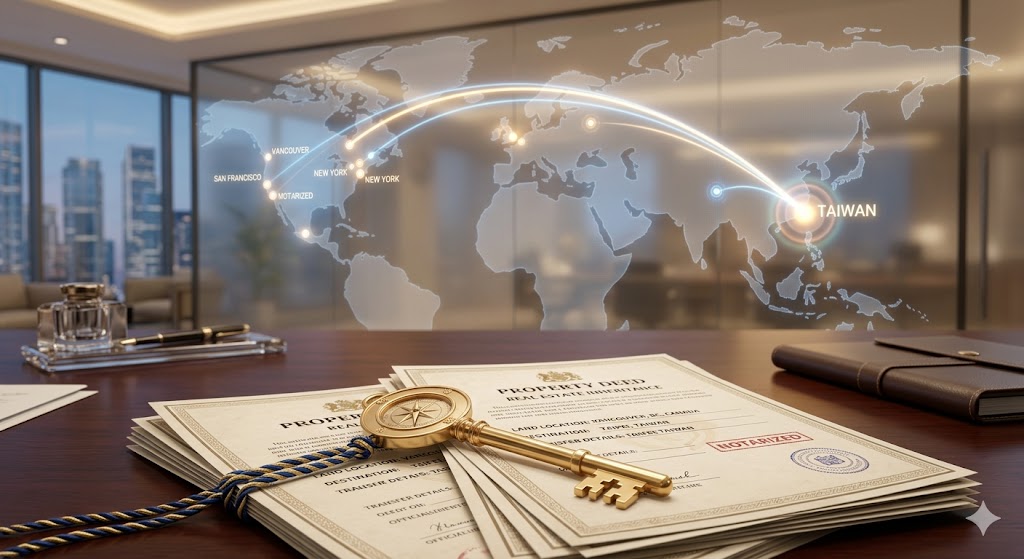
[Cross-Border Inheritance Guide] Living Abroad? How to Handle Taiwan Inheritance? 5 Key Steps & Documentation Without Traveling to Taiwan
Many Taiwanese living in the U.S., Canada, or Australia, when facing the passing of an elder back home, encounter a practical question beyond their grief: "Do I have to return to Taiwan to handle the inheritance?" or "How will my second-generation children, who do not speak Chinese, take over assets in Taiwan in the future?"
In fact, cross-border inheritance is more than a single administrative procedure; it is a comprehensive project involving document authentication, tax filing, real estate law, and family coordination. This article will deconstruct the practical process to help you or your family members efficiently and legally protect family assets from abroad.
Can You Handle Inheritance Without Returning to Taiwan?
The short answer is yes. However, it requires a precise combination of "legal authorization" and "document authentication."
In practice, overseas heirs typically choose one of three approaches:
Full Remote Representation (Most Common):
Suitable for busy professionals, heirs scattered across different countries, or those unable to travel long distances. A lawyer drafts a legally binding Power of Attorney (POA), which is authenticated by the overseas mission (e.g., TECO), allowing the lawyer to handle the entire process in Taiwan.
Return Once, Authorize the Rest:
Suitable for those who need to personally coordinate asset distribution (Partition Agreement) with relatives or handle items of sentimental value.
Must Return Personally (Rare):
Only occurs when identity proof is severely lacking, there is a major dispute over inheritance rights leading to litigation, or the POA is rejected due to improper wording by banks or land offices.
Standard Operating Procedure: 5 Steps to Manage Taiwan Assets
To ensure a smooth process, we recommend following this step-by-step guide:
Step 1: Identity Verification & Feasibility Check
Key Point: Clarify the order of legal heirs and check for a will. If a will exists, assess whether it infringes on the "Compulsory Portion" (Reserved Portion) of specific heirs.
Preparation: Collect overseas birth certificates, marriage certificates, and death certificates.
Lawyer's Tip: Many second-generation immigrants have names on their passports that do not match Taiwan’s household registration. An "Identity Consistency Certificate" must be processed first. If you are concerned that being removed from household registration affects your nationality or inheritance rights, please consult a professional lawyer.
Read More: [Taiwan Inheritance Guide] Household Registration Cancellation & Foreign Heirs Explained
Step 2: Asset Inventory in Taiwan
Key Point: Many overseas heirs are unaware of the full scope of assets in Taiwan, such as hidden bank accounts or long-unattended stocks.
Legal Assistance: A lawyer can query the Financial Supervisory Commission and the National Taxation Bureau on behalf of the heirs to obtain a complete list of financial assets and real estate holdings.
Step 3: Filing Estate Tax (Time-Sensitive!)
Key Point: Taiwan estate tax must be filed within 6 months from the date of death.
Risk: Delays will lead to penalties. Even if assets do not reach the tax threshold, a "Tax Payment or Exemption Certificate" is required for subsequent title transfers.
Step 4: Document Authentication & Power of Attorney (POA)
Key Point: This is where overseas applications most often fail. The POA must be Notarized (Notary Public) and Authenticated by an Overseas Mission (e.g., TECO).
Pitfall Guide: If the POA content is too vague, it is often rejected by land offices or banks. A lawyer will draft specific wording that meets Taiwan’s regulatory standards.
Step 5: Inheritance Registration & Asset Disposal
Key Point: Finalizing real estate title transfers and closing bank accounts.
Extended Support: If the property involves Urban Renewal or Dangerous/Old Building Reconstruction, a lawyer can participate in meetings to evaluate distribution terms and protect the rights of overseas owners.
Three Common Pitfalls in Overseas Inheritance
Article 17 of the Land Act:
If an heir has completely lost ROC nationality (foreign national), they cannot legally hold agricultural or forest land. Such land must be sold within three years of registration.
Disagreements Among Heirs:
When some wish to sell for cash while others want to keep the property for rent, failure to reach an "Estate Partition Agreement" leads to a "Joint Ownership" deadlock, making future disposal extremely difficult.
Cost of Long-term Inaction:
Delaying inheritance makes documentation harder to find. As the number of heirs increases in subsequent generations, legal relationships become highly complex.
Frequently Asked Questions (FAQ)
Q1: I hold a foreign passport. Do I need to return to Taiwan for a Seal Certificate (印鑑證明)?
No. Those residing abroad can use an "Authenticated Power of Attorney" to replace the Seal Certificate.
Q2: How can a lawyer help if the second generation does not speak Chinese?
Our firm provides professional bilingual services. We can translate property documents and complex partition agreements into English, or explain them personally via online meetings to ensure overseas children clearly understand their rights.
Q3: Can Taiwan estate tax be deducted from U.S. taxes?
U.S. citizens or Green Card holders must report global assets. Under certain conditions, estate taxes paid in Taiwan can be claimed as a credit against U.S. estate tax. We recommend consulting lawyers and accountants with cross-border experience.
Actionable Advice for Overseas Heirs
Cross-border asset disposal is a meticulous project management task. Before starting, ask yourself these three questions:
Do I know exactly what assets exist in Taiwan (including bank accounts and land)?
Is there a consensus among all heirs regarding distribution?
Will my authorization documents pass the strict scrutiny of Taiwan’s land offices?
Secure Your Family Legacy Without Traveling to Taiwan
If you are uncertain about any of the above, welcome to schedule our cross-border video consultation service. We specialize in assisting overseas compatriots in completing family asset succession with peace of mind.
Read More: How Foreign Companies Can Use Taiwan Tax Treaties